Parent field
The saturated background condition in which local baryonic phase responses exist.
RBFL 6.0 · 3D-first framework
The current 3D RBFL acceleration law remains unchanged. The new advance is the physical explanation: sine-phase intersections in a volumetric field can amplify, suppress, or cancel the local coherence response.
gRBFL(r,t) = gb(r,t) + CΦ(r,t)√(aΦ|gb(r,t)|) ĝb
The law is unchanged; sine-intersection behavior explains CΦ(r,t).
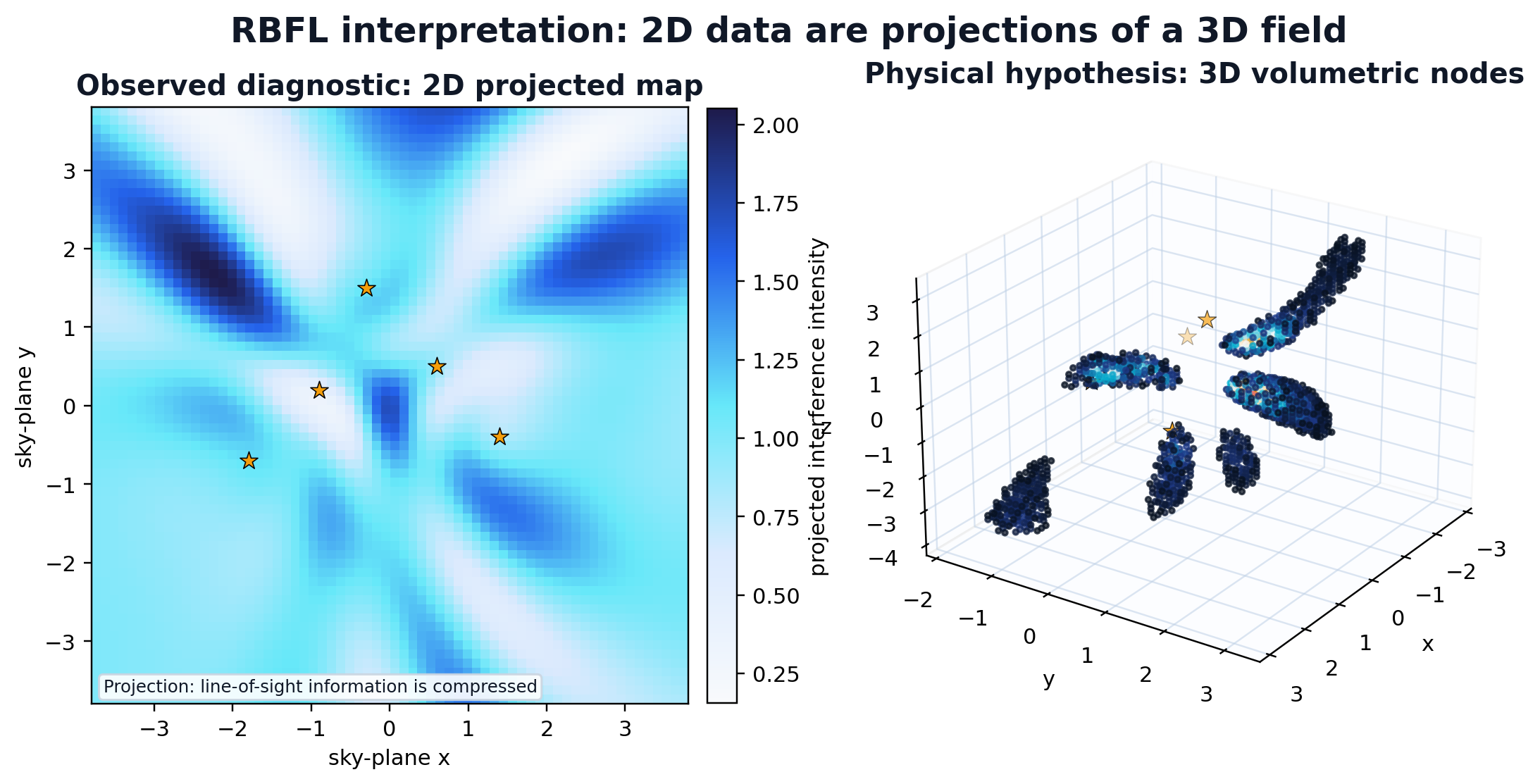
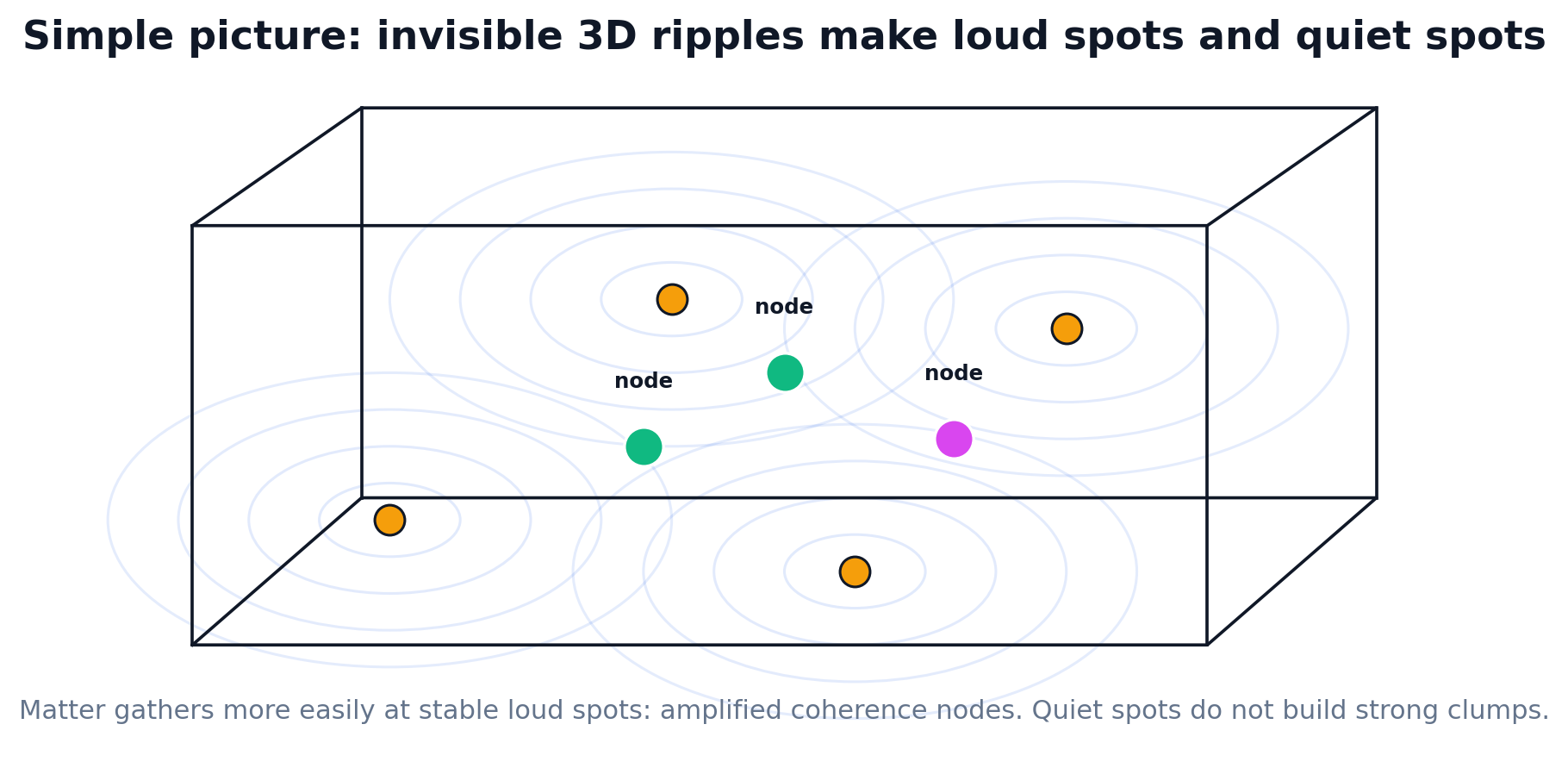
Core statement: observed 2D data are projections of a 3D volumetric field. Baryonic matter anchors phase-compression volumes. Constructive sine-phase intersections create amplified coherence nodes. Destructive intersections suppress or cancel response. Seemingly random matter clumping may be the projected signature of hidden 3D amplified node geometry.
1 · Why 2D came first
Galaxy images, rotation curves, lensing maps, and density maps usually reach us as lower-dimensional measurements. Earlier 2D or radial RBFL forms were therefore useful diagnostic tools, not the final ontology of the field.
Simple picture: a camera sees a shadow on a wall, but the real object is a 3D shape in the room.
2 · Why 3D is required
Baryonic matter occupies space. Acceleration has direction. Phase overlap happens through volume. The true RBFL object is therefore Φtotal(r,t), not a flat surface.
The saturated background condition in which local baryonic phase responses exist.
Visible matter behaves as a phase-compression anchor, contributing local volumetric response.
Φtotal(r,t) = Φparent(r,t) + ΣΦi(r,t)
3 · The 3D sine-intersection mechanism
General overlap is not enough. Some intersections amplify. Some suppress. Some cancel. In RBFL, coherence means stable constructive phase alignment.
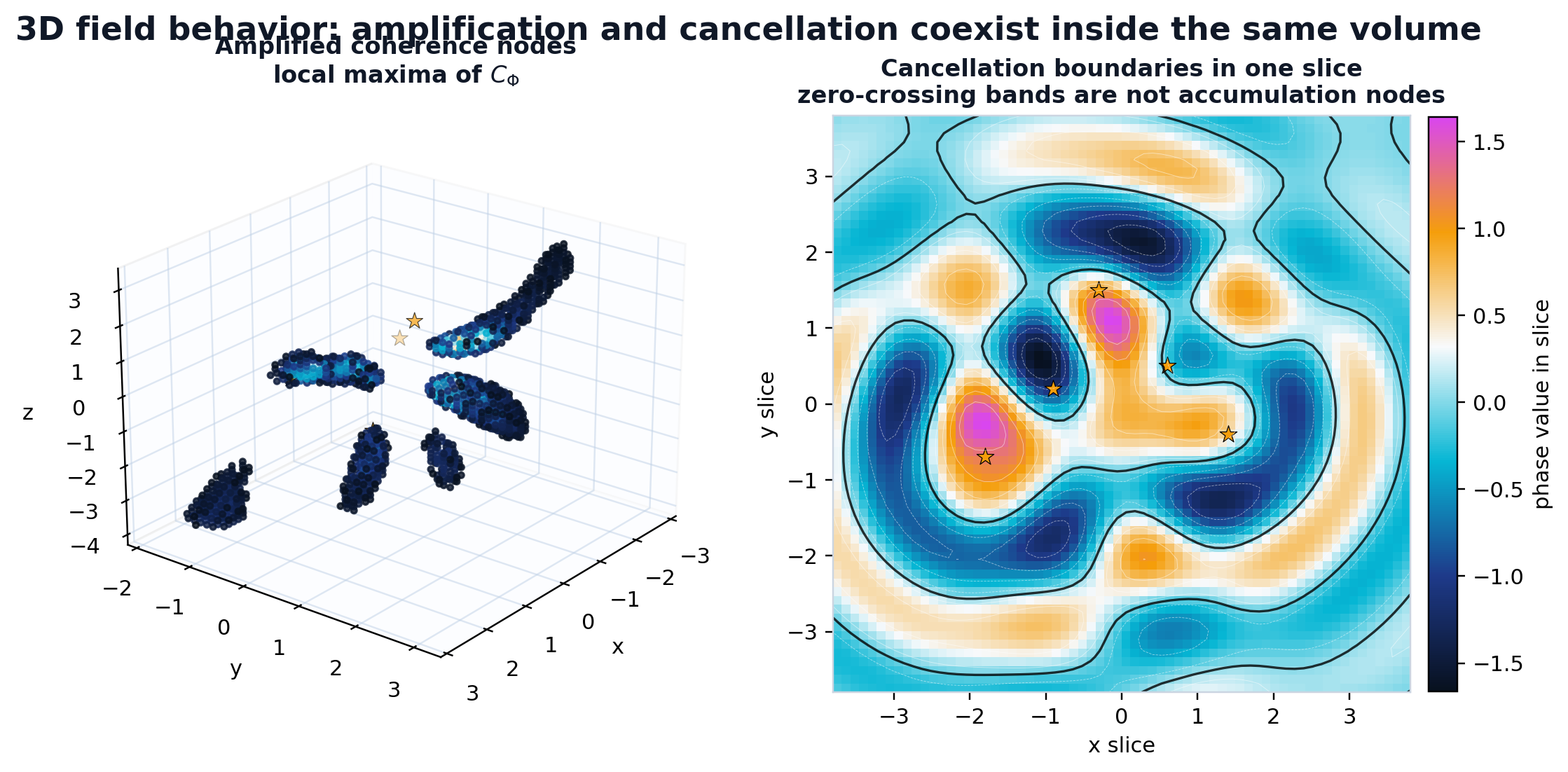
Amplified coherent node: stronger local phase-compression response.
Baseline RBFL behavior without strong amplification or suppression.
Suppressed or cancelled response: weak accumulation environment.
4 · Apparent random matter clumping
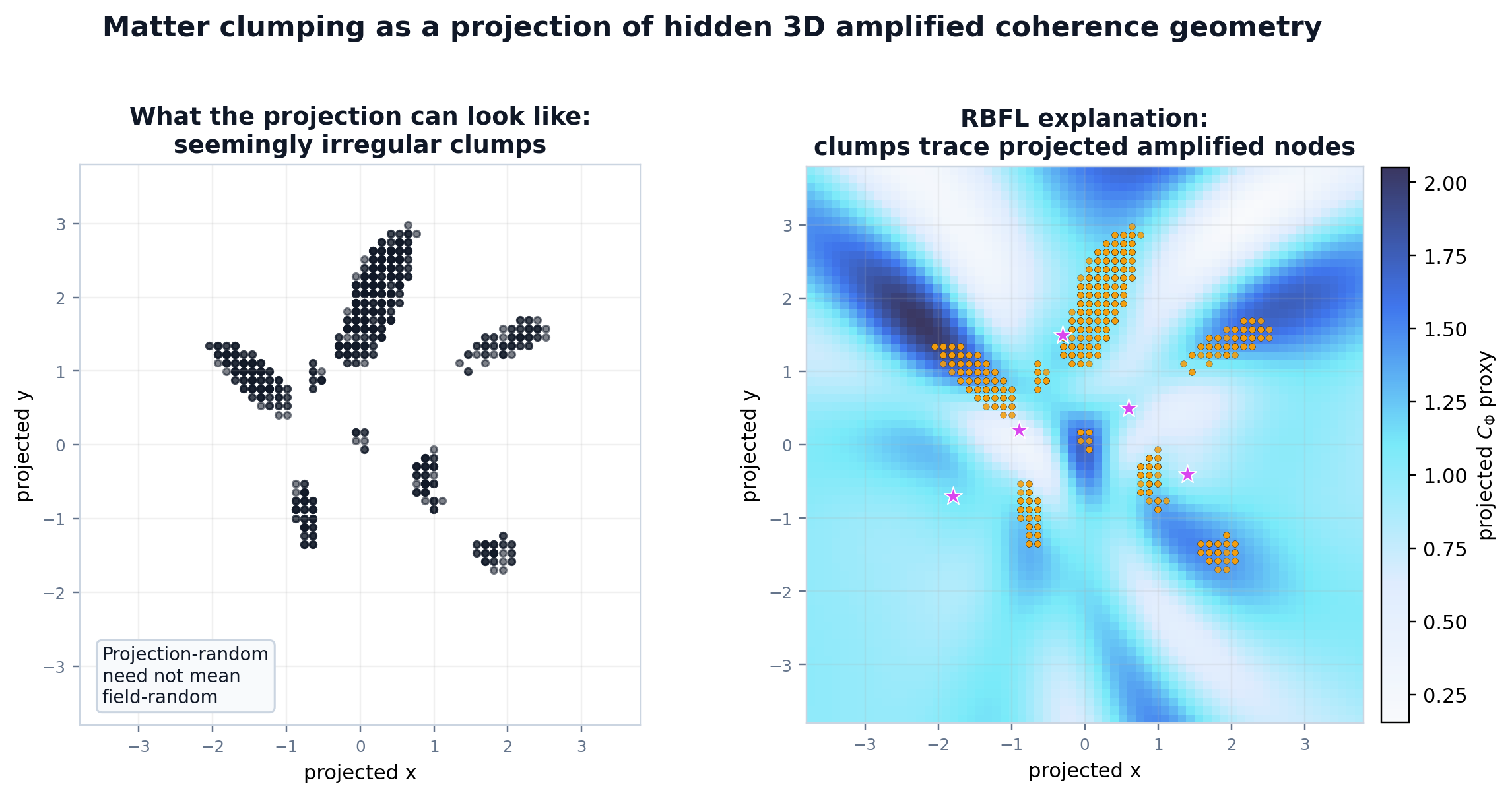
Clumps that appear irregular in a projected map may be the 2D shadow of hidden 3D amplified coherence nodes. The mechanism does not claim matter is created from nothing. It proposes that existing baryonic matter organizes more easily near stable amplified nodes.
5 · Scaling from local structure to the cosmic web
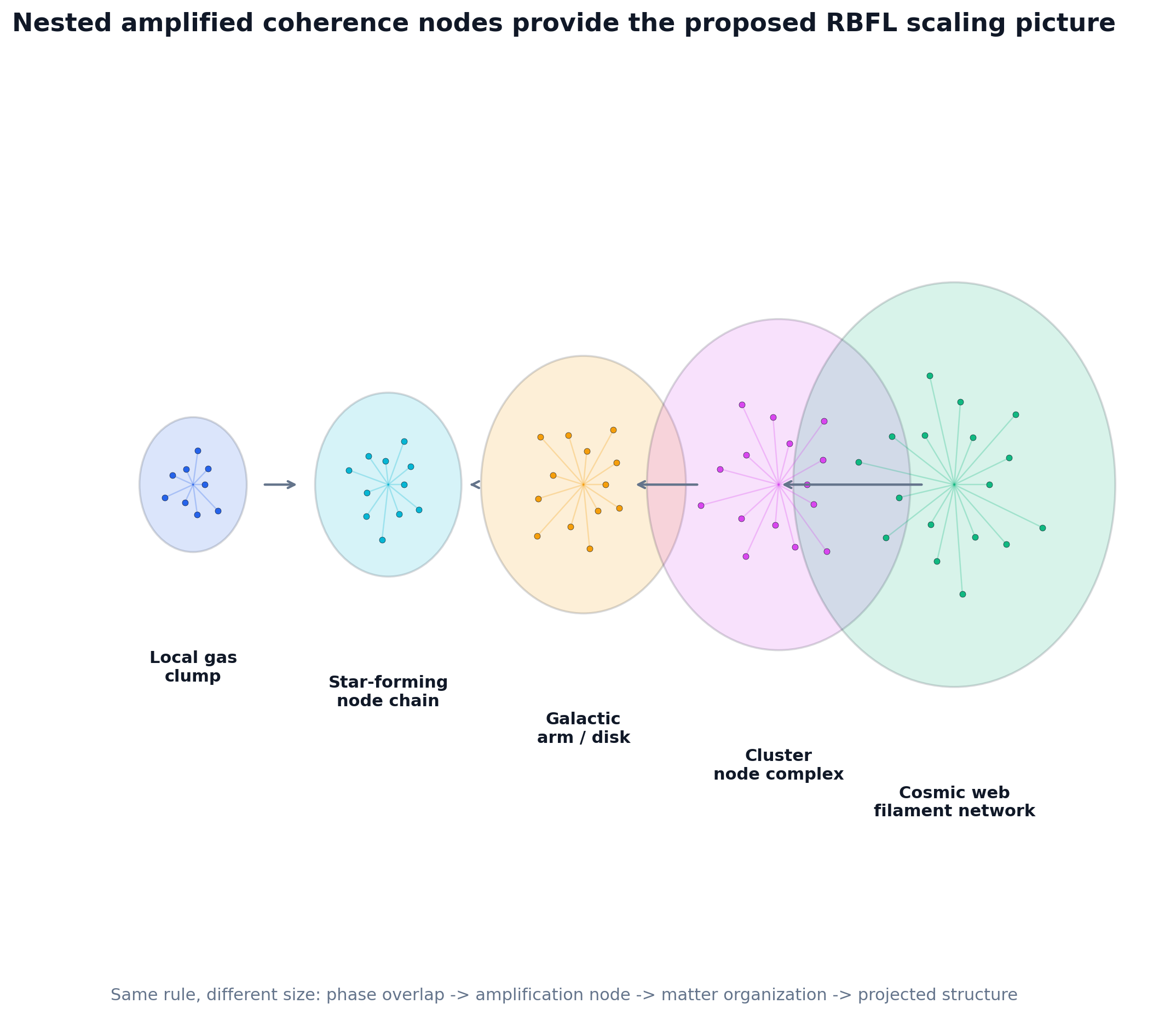
Local clumps, star-forming chains, galactic arms, cluster substructure, and cosmic-web filaments can be interpreted as different scales of the same volumetric node behavior.
Same rule, different size: phase overlap → constructive amplification → stable node → matter organization.
Status
RBFL has reached a closed explanatory chain: law, 3D field interpretation, sine-phase amplification/cancellation, coherence response, matter organization, and scaling now connect without adding a new force term.
The next standard is empirical closure: reconstruct CΦ from baryonic inputs and test whether residual gravity, projected clumping, lensing structure, and void-like regions follow the predicted 3D node geometry.
Unchanged 3D law · mechanism explained
The front-page update does not add a new force. It explains the existing coherence factor as the local result of volumetric sine-phase amplification, suppression, or cancellation.
gRBFL(r,t) =
The current 3D law is unchanged; sine-intersection behavior explains CΦ(r,t).
The ordinary baryonic gravitational acceleration, derived from visible baryonic structure before residuals are inspected.
The proposed phase-carrier acceleration scale that sets the saturated low-acceleration response strength.
The local volumetric phase-interference response: CΦ>1 at amplified nodes, CΦ≈1 at baseline saturation, and CΦ<1 in suppressed/cancelled regions.
Imagine invisible 3D ripples. Loud stable spots are amplified nodes. Quiet or cancelling spots do not collect matter as easily. That is the picture behind the new homepage.
The sine-intersection mechanism explains the existing CΦ(r,t) term. It is not inserted as a new halo, force, or after-the-fact patch.
The new white paper is surfaced locally and through DOI 10.5281/zenodo.20724744 so readers can cite the current 3D Sine-Intersection release directly.
Interactive 3D Sine-Intersection Visualizer
The engine remains educational and browser-generated. It now frames the old projection unit as a 3D node visualizer: baryonic anchors, phase overlap, amplified coherence, cancellation, and residual projection are separated for clarity.
SPARC radial profile
Locked law · sine-intersection explanation
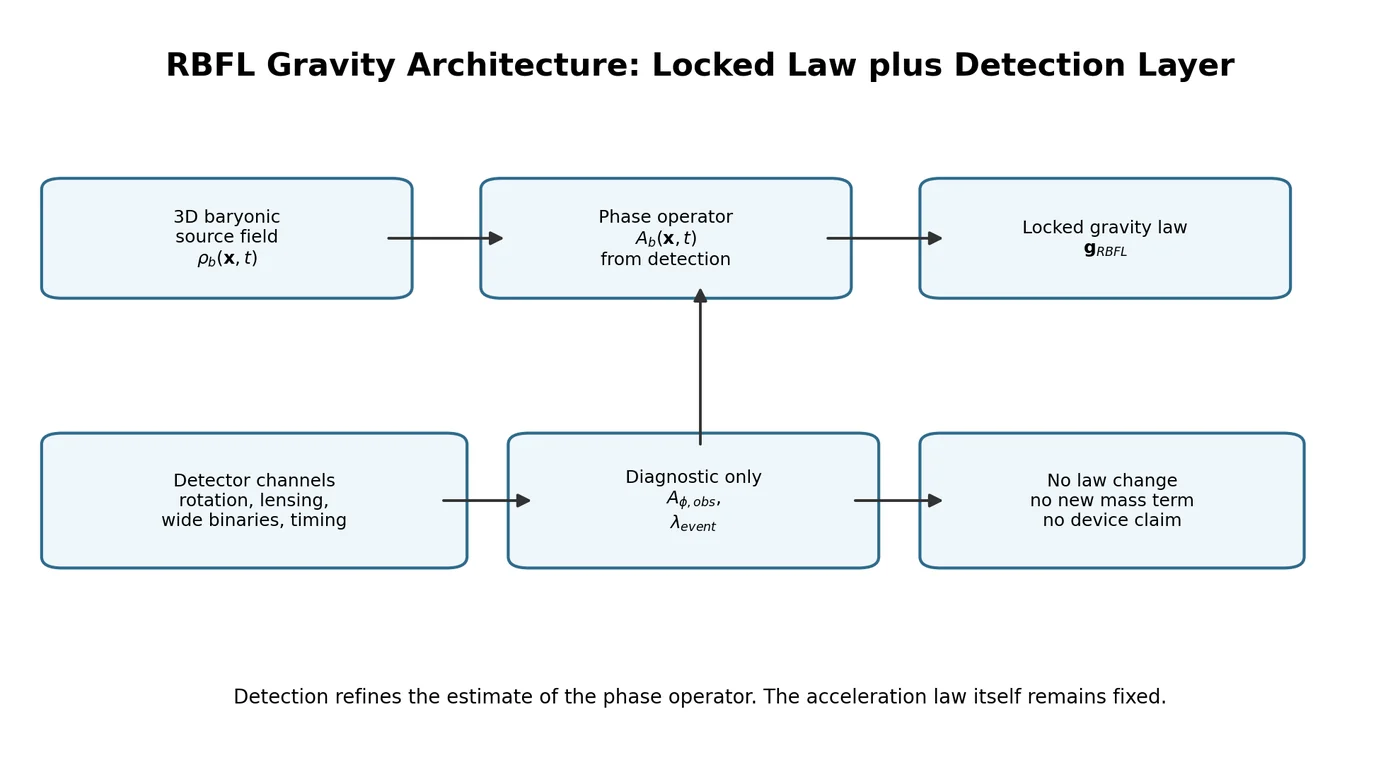
gRBFL = gb + Aeff√(aφ|gb|)ĝb
The compact formula uses CΦ as the public shorthand for the local phase response. The new homepage explains that response through 3D sine-phase amplification and cancellation.
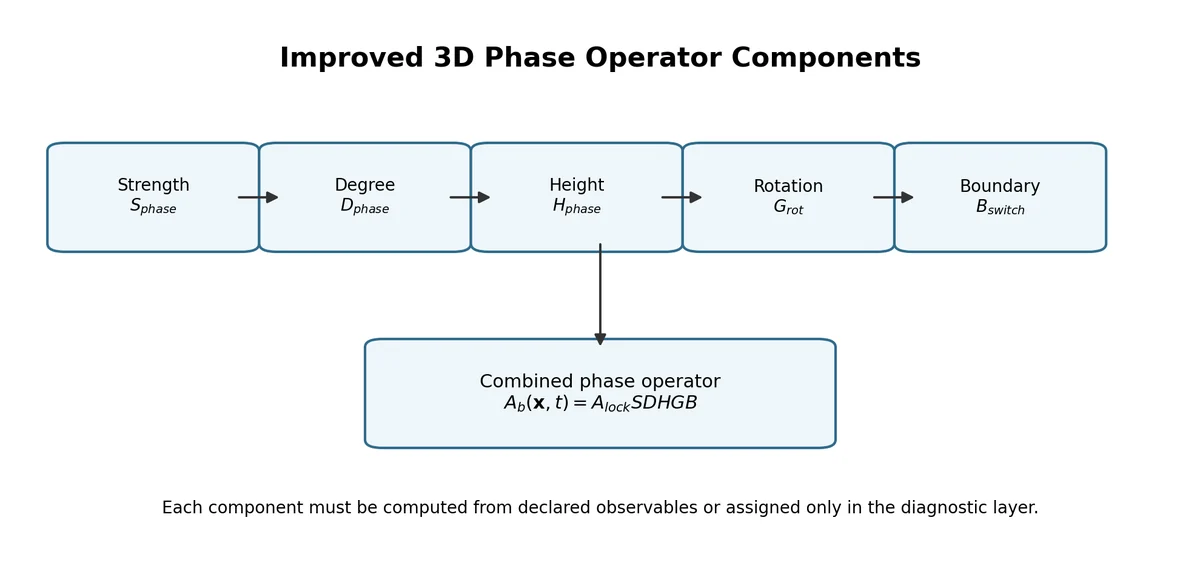
CΦ ≈ AlockSphaseDphaseGrotBswitchHproxyP3D
The sine-intersection view gives the physical picture under the stack: constructive volumetric intersections raise CΦ, destructive intersections suppress it, and projected maps can look random even when the 3D field is ordered.
Aφ,obs = (gobs − gb) / √(aφgb)
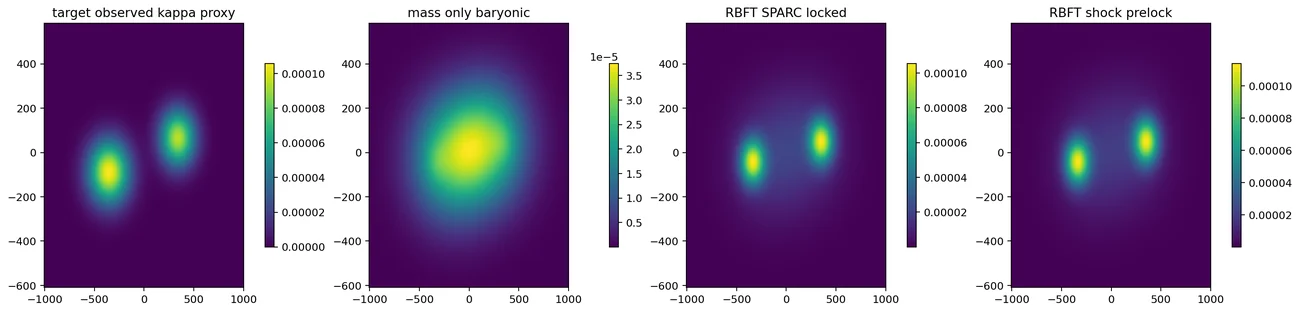
Residuals, NGC7331 phase gauge, lensing/event bands, wide binaries, and timing clues are described as diagnostics after prediction, not as new acceleration terms.
Benchmark cockpit
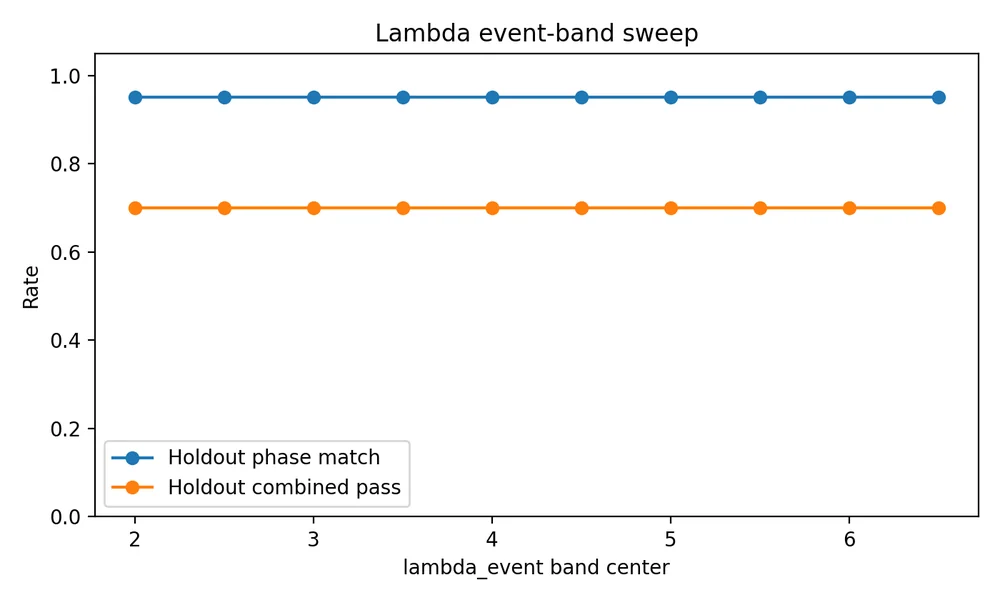
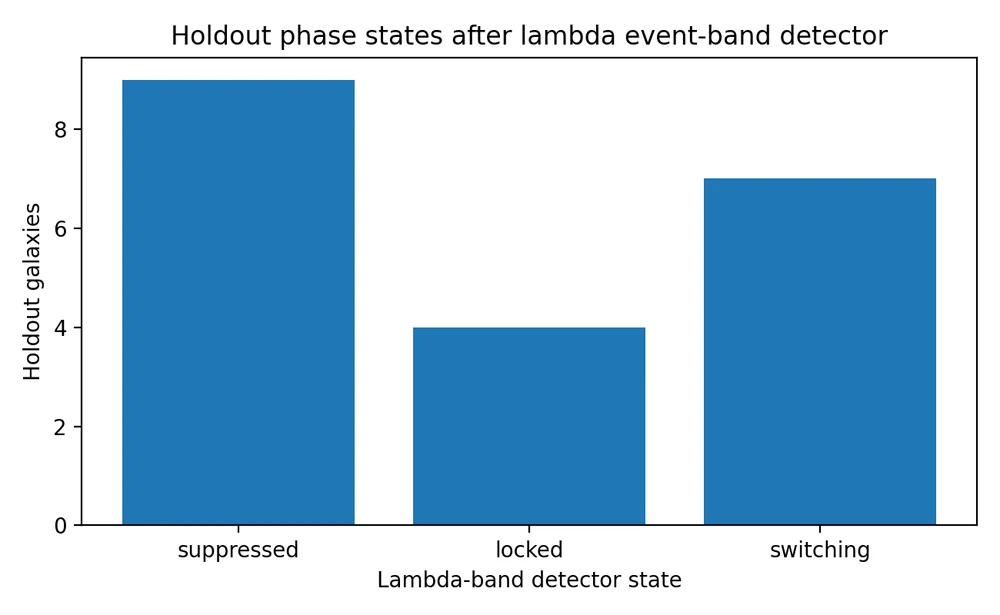
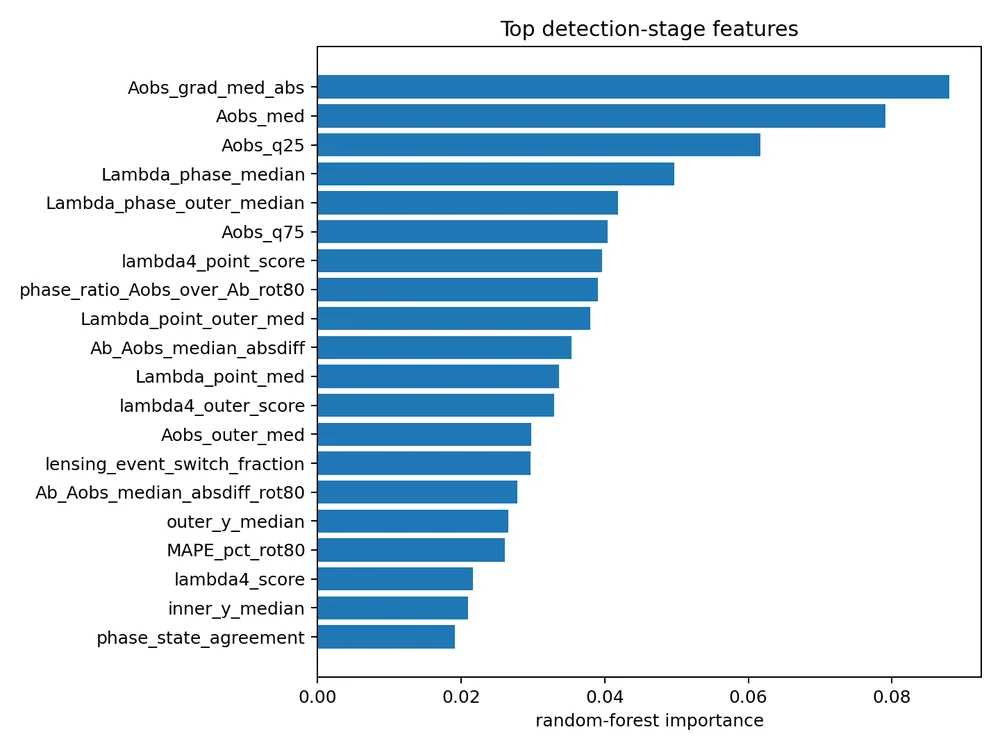
The page keeps the improved detector result beside the unchanged velocity pass so technical readers see the strength and the limitation at once.
Shown as an adjustable event-band detector result. The law itself is not retuned.
Reported side-by-side to avoid equating detector classification with proof of gravity.
Frozen-parameter blind benchmark against MOND/RAR and dark-halo baselines using the same baryonic inputs and holdout galaxies.
Speculative engineering · separated from the galaxy law
These ideas are presented as test pipelines and future falsification targets only. They do not validate the galaxy law, do not change the compact formula, and do not claim a working device.
Δsignal → phase-coherence residual after known physics
Future tests may look for residual timing, orientation, wide-binary, lensing, or PAD-T style phase signatures after standard explanations and controls are applied.
Disclaimer: no working gravity-engineering method is claimed, and detector residuals are not inserted into gRBFL.
RΦ ≈ 1 → neutral parent-field band → ignition proxy
The fusion extension asks whether coherent nested-field geometry must be satisfied before a star-like ignition state becomes stable. It is a separate engineering hypothesis, not a reactor design.
Disclaimer: not a construction guide, not evidence of achieved fusion, and not validation of RBFL/RBFT gravity.
Public-facing narrative
Start from observed baryonic structure: disk scale, gas, rotation curve rows, and known mass proxies.
Treat baryonic structures as phase-compression anchors inside a saturated 3D parent field.
Let volumetric sine-phase intersections amplify, suppress, or cancel the local coherence response.
Read CΦ(r,t) as the local result: amplified node, normal saturation, or cancelled/suppressed region.
Test whether projected residuals, clumps, filaments, and void-like gaps trace a reconstructible 3D node geometry.
Research extension · ignition field handoff
The attached white paper presents the ignition question as a field-transfer condition: confinement remains important, but a stable ignition state is framed as a structured handoff between the compressed local phase region and the surrounding parent field.
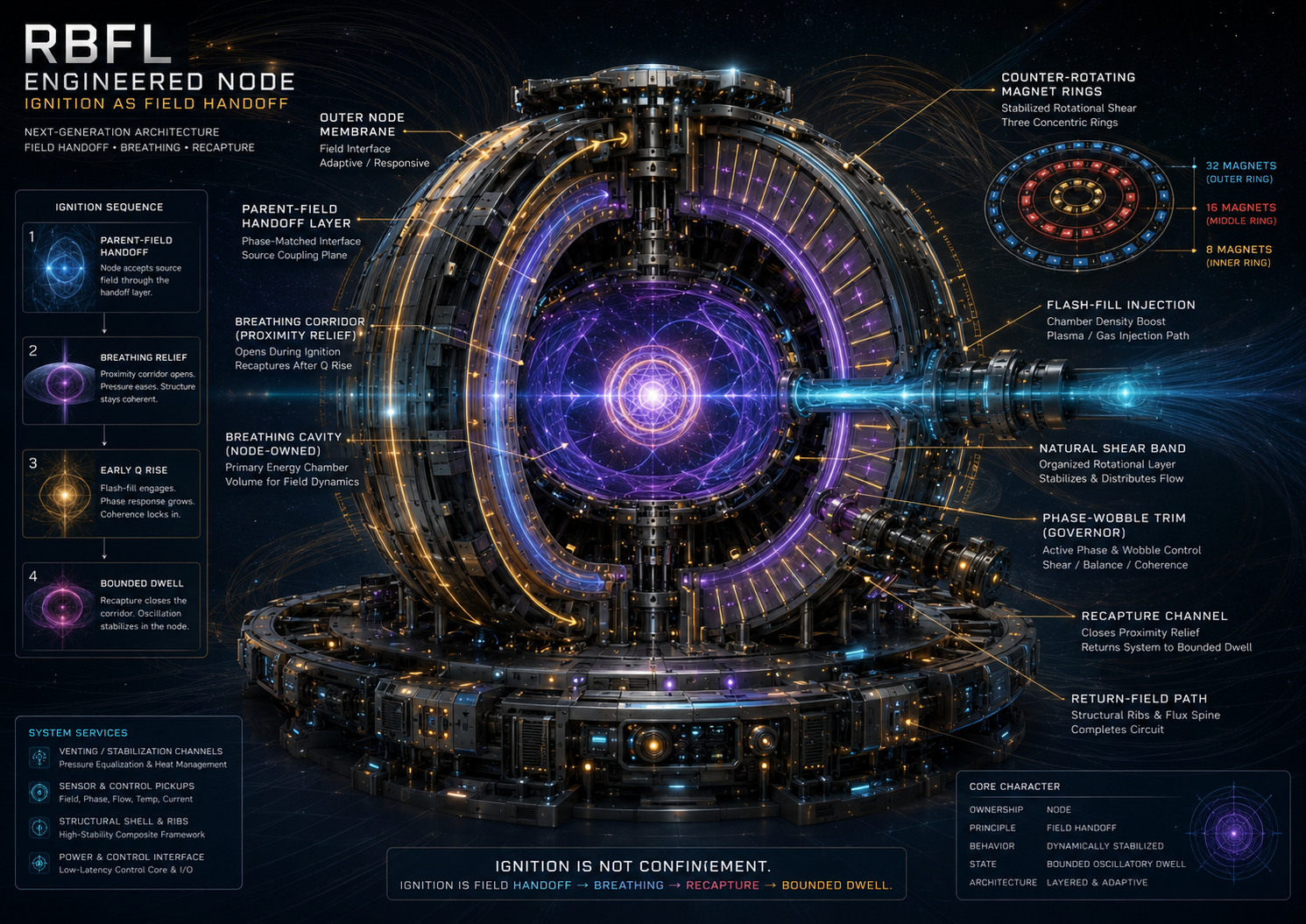
The research separates ordinary confinement language from the proposed RBFL/RBFT interpretation: field geometry, phase continuity, and handoff stability are the center of the test frame.
The download package preserves the supporting output files alongside the white paper so the new field-handoff section has both a narrative entry point and a direct reproducibility trail.
This section presents a hypothesis and its internal output materials. It does not change the existing RBFL site text, and it does not claim demonstrated fusion, reactor design, or physical validation.
Searchable research guides
These focused pages separate the framework, the galaxy-rotation problem, the SPARC reproducibility path, and the publication record so readers and search engines can reach the most relevant evidence directly.
A plain-language introduction to the Radial Baryonic Field Law, its 3D phase-state interpretation, locked acceleration law, and scientific status.
Read the RBFL overview → Astronomy questionHow RBFL frames the relationship between visible baryonic structure, measured orbital speeds, and residual acceleration.
Explore the rotation-curve question → Open testingThe public dataset, frozen-parameter benchmark path, downloadable packages, diagnostics, and limitations.
Review the reproducibility path → Citable recordStart with the current 3D Sine-Intersection paper, then follow the unified-law and reproducibility publication trail.
Browse RBFL publications →Publications · downloads · Zenodo bridge
Latest additions · July–September 2026
The latest theory asks whether time-evolving three-dimensional wave domains can produce secular dark-sector accumulation and whether an independently allowed coupling could support energy conversion. It is a speculative, falsifiable theory note—not a claim that dark matter has been captured or harvested—and its separate RBFL correspondence layer does not modify the locked RBFL gravity law.
Disclaimers
This site presents RBFL as a speculative research programme with an interactive educational/demo projection layer. The new front page states that internal logic is closed, not that RBFL is proven. The site does not claim experimental verification, a completed relativistic theory, a replacement for general relativity or dark matter, proof of lensing, working gravity engineering, working fusion engineering, or a reactor design.
RBFL is presented as a baryon-derived phase-field framework with a locked law and an improving detector that becomes more falsifiable through frozen-parameter tests.
No proof that dark matter is disproven, no claim that wide binaries or lensing arcs prove RBFL, no claim that phase can be directly controlled or engineered, and no claim that the fusion hypothesis validates the galaxy law.
An educational 3D sine-intersection projection generated from rounded SPARC and detector metadata. It is not a publication-grade numerical solver or proof of physical nodes.