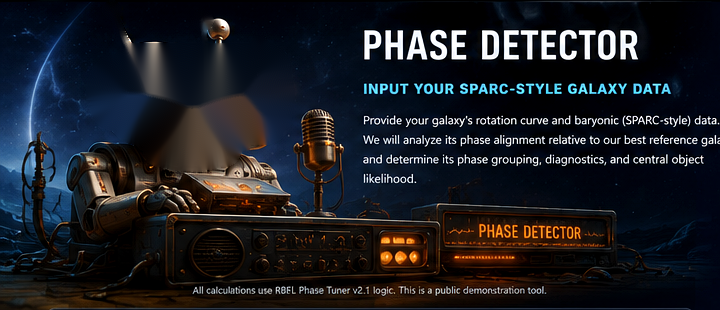
Phase Detector
Input SPARC-style galaxy data, compare it to the closest RBFL reference profile, and generate a provisional phase-alignment readout with outer-rim diagnostics, prediction prompts, and a central-object estimate.
Boundary: this is a public demonstration interface. It is designed for exploration, teaching, and pre-screening. It is not a substitute for source SPARC reductions, peer review, or the research-grade Phase Tuner.
Paste radius, observed velocity, baryonic velocity, and uncertainty if available.
The detector searches the bundled galaxy library for the closest reference profile.
It estimates alignment, coherence, drift, outer-rim separation, and spike behaviour.
It returns phase implications, outer-rim tests, binary-star bridge prompts, and caveats.
Run a provisional phase alignment
Paste clean rotation-curve rows below. The detector runs entirely inside your browser; the public site does not upload or store your data.
Awaiting data
No phase implication yet.
No outer-rim prediction yet.
No binary-star bridge yet.
The detector cannot identify a single central star from rotation data alone. It estimates a central-object class from inner-radius velocity behaviour.
- Load or paste a galaxy to see validation prompts.
Use at least 8 radial points where possible, with uncertainty columns and a clear baryonic proxy.
Data format guide
Paste one row per radial sample. Header names are flexible, but the detector needs radius, observed rotation velocity, and a baryonic velocity proxy.
radius_kpc,vobs_kms,vbar_kms,err_kms
0.50,42,38,5
1.00,75,68,5
2.00,118,100,6
What the detector calculates
It compares your input to the closest bundled reference shape, estimates baryonic alignment, outer-rim separation, coherence, residual stress, and spike-like behaviour, then assigns a provisional phase grouping.
The output is a navigation layer. It should guide deeper analysis, not replace full reproducibility work.
Phase Detector is the front door to the Phase Tuner idea.
The long-term goal is to connect this interface to verified SPARC tables, uncertainty envelopes, RBFL reproducibility outputs, and downloadable per-galaxy reports.